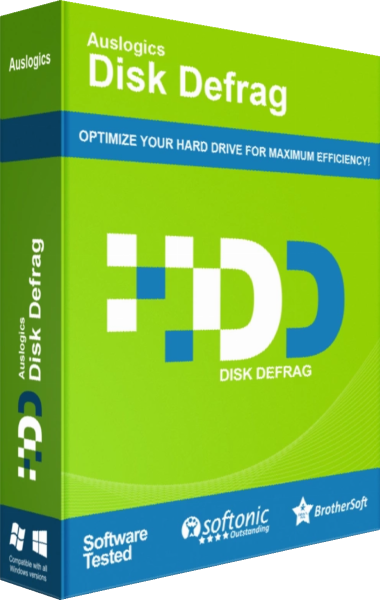



Analyze and defragment hard drives with Auslogics Disk Defrag
Auslogics Disk Defrag is a Windows utility focused on mechanical hard disk drives. It analyzes fragmentation and reorganizes scattered file fragments to help reduce disk access overhead.
Start with analysis of the selected HDD. Review the result before running maintenance rather than assuming fragmentation explains every slow application.
Check the drive type before choosing an action
The drive list identifies HDDs and SSDs. The current Disk Defrag product focuses on HDD maintenance and does not run regular defragmentation on detected SSDs.
A computer can contain both types of storage. Confirm which drive holds the files you want to maintain, especially when Windows and personal data are stored on different devices.
Reorganize files and consolidate free space
Disk Defrag provides file defragmentation and free-space consolidation. These tasks address existing file layout and scattered free areas on a hard disk.
Check that the drive has working space available and avoid competing large file transfers while maintenance is running. Review the completed analysis rather than repeatedly starting a full pass without checking the result.
Target a file or folder when appropriate
Selected-file and folder defragmentation lets you focus maintenance on specific data instead of processing the whole drive. This can be useful for a large project folder or game installation stored on an HDD.
Compare access or loading behavior under similar conditions. File organization is only one factor: processor load, memory, graphics hardware, and network activity can also affect the experience.
Review the edition before relying on advanced options
Disk Defrag, Disk Defrag Pro, and Disk Defrag Ultimate have different feature sets. This page describes the standard product without treating every advanced function as included.
Check the edition you select before relying on scheduling or additional maintenance tools. Boot-time optimization and advanced SSD algorithms advertised for Ultimate should not be assumed to belong to this listing.
Assess results without fixed speed expectations
Defragmentation may help an HDD workload affected by scattered files, but it does not guarantee a particular speed increase or higher game frame rates. Measure the task you actually want to improve.
If delays persist, investigate other causes instead of repeating the same operation. Disk maintenance does not repair every hardware problem or replace a backup of important files.
Compare alternative maintenance workflows
For other approaches to drive analysis and automatic maintenance, see IObit Smart Defrag Pro and O&O Defrag 32. Compare their handling of your drive type and the controls you need.
Keep recovery copies separate from the drive being maintained. Before making substantial storage changes, confirm that you can retrieve important files from those copies.
See our O&O Defrag 32 vs Auslogics Disk Defrag comparison for differences in drive handling, maintenance controls and edition scope.